
Sandi Calistro
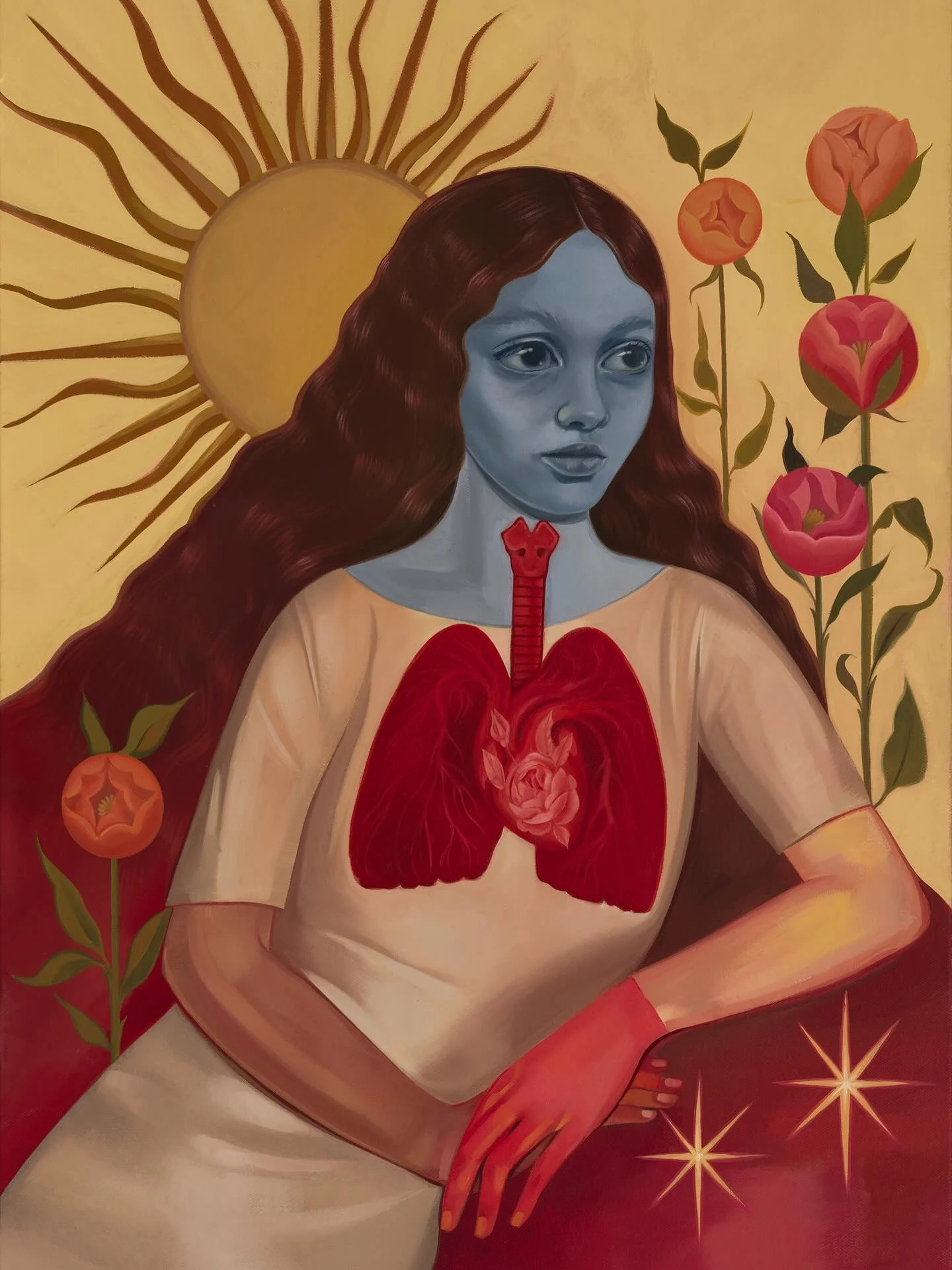
The Face
of God
He is frustrated with this one. He is struggling to get the exact right glance of her eyes. There is a light behind her and shadows should fall under her chin, but he refuses to let this reality spoil her beauty. He leans back and squints. He inhales short sharp puffs of air. He shakes his wrist as if to blame his hand or the brush for his short-comings. He leans into the painting, holding in the air that is bursting from his chest. He wants a moment of death. He wants to deny himself the chance to exhale until he can get things right with her face.
He guides his left hand with his right, drawing the paintbrush across the canvas. He is painting a woman, robed in blue and gold. Her eyes are fixed like two stuck stars that somehow seem to sparkle. His paint is primitive, but he has been making these images for so long that he is adept. He moves close to the image, to see it, to see her face appear where there was nothing.
She was once nothing until she became everything. And now he wipes the tip of the brush so that it sharpens. He paints the fine thin lines of her lips and nose and eye lids. The canvas sits on a stand on his old stained table in the studio just off the corner of his modest home. He is not a rich man, but he is not poor either. His icons (because this is what he paints, icons of her, the mother of God) earn him what he needs to live and so does his medical practice.
His beard is streaked in gray and white and silver with just the memory of the black that once dominated his face. He looks religious. He looks rich. Tall and dark like many Greek men. He is a gentile in a world of Jews. It’s not just paint that stains his fingers but ink as well. He is a writer. While the ill and the lame celebrate his life, it will be the readers of his writing who will celebrate him long after he has died.
But these are all thoughts that escape him as he sits, angry at himself. Angry at the painting. He twists his long eyebrows in an expression of pain. The paintings are never perfect and never finished, but he feels an obligation to send them off into the world. He places the brush in the cup next to the canvas and clenches his fingers in the shape of a claw.
“Damn.”
There is no relief for him. He leans back and imagines smashing the painting. He could. He has. In the past. Until one day, He came to him as a warning. It is my mother, the vapor said to him in the dim dying light of twilight as he dozed on his couch in the studio. Remember, beloved physician, this is my blood and flesh you paint. She lives for you. She lives for all of you.
He woke that day in terror. The Rabbi had never visited him, even when he was so close to Paul like a shadow when Paul was in jail. Christ never spoke to him or through him, and he was never sure that his writings were right or accepted by God. It wasn’t until he started with the paintings that Christ appeared to him many times. It scared him. He could not feel the peace that many describe when in the presence of the lord. In fact, it left the smallest seeds of doubt in his mind as to whether or not others really saw the smiling, loving Lord in the blackness of sleep when his vision of Christ was always a warning or a threat.
“Father?” The familiar voice of his ward called from the alley just outside his kitchen window. “Mathias” was a useful boy, but at times a dull fool. Luke had saved him when his family had the illness, but he could not save any of the others. As a result, Luke took on the child almost as his own. While the boy frustrated Luke with his lack of morals and feeble mind, he felt affection for him. It was hard not to see that the grief of the child’s losses were the reason for his ambivalence. Despite all of Luke’s teaching, Mathias’ mind slipped this way and that down the dark alleys of Boeotia. It was ironic. Here was the mother of God, created by his threadlike hands, leaning on a short easel, one image painted after another, and yet Luke had no power to teach the boy right from wrong.
“Mathias. I am in the studio painting. What is it, my son?” There was a grunt. The boy stomped into the room and landed on the couch.
“Nothing, Father. I was just testing you.”
“Testing me?”
“Yes, to see if you were working!” His voice deepened. He was changing from a boy to a young man, yes, but that change in voice was meant to injure Luke.
“Why would I not be? Have you known me not to work?”
“No, father. Work, work work…” He tossed the pillow into the air and balanced it with his feet. “WORK!”
“You have your work, and I have mine.” There was silence. Luke picked the brush from the cup and returned to the painting. “What? You don’t think I know of your work, Mathew?”
“Mathias–”
“I have my spies, young man. I see you picking pockets. Tricking the old and the foreign.” Luke took a deep whole breath but let it out and ran the brush across the chin of our lady and savior. “I see you….Mathias.”
There was a shift in the weight of the room. The young man got several years younger and sat up straight on the couch. “I. I do not. I am not.” His face twisted and his shoulders jutted backwards as he thrust out his chin. “You don’t SEE me. It’s a trick! You are tricking me into making a confession that would be false.”
Luke kept painting. The sound of his brush scratching across the canvas was loud enough to expand the tension. Luke kept painting, saying nothing. His silence was enough.
“We can’t all be saints, father.”
“Oh, I am no saint, Mathias. I have sinned, too. Worse sins. Bigger sins than any of yours.”
The boy wanted to reply, but for one of only a few times in his life, his simple mind stopped his tongue.
“Yes, I am a sinner. I’ve lost lives. Caused families to decry God. They turned their back on the one who never lost love for them because I was weak. I was stupid. I was….DAMN” Luke touches the canvas with his thumb, wiping away a mark that was too black. “You see?” He turned to the boy. “Even the holy mother isn’t safe from my worthless hands.”
Mathias was still, piecing together his insufferable anger with the slim sliver of pity that Luke evoked in him. “Yes. Your hands are wicked.” His voice was like the hiss of steam from a tea pot.
That morning, Mathias (Matthew) found Skotádi in the street, and ran with him to the waterfront to see the visitors coming off the boats. There was a small fortune to be made from the coins and purses living in their shallow pockets. They worked all morning until they ran in different directions, chased by Romans, eventually finding the wet corner of an outhouse, their “hideout.”
“A killing, Matthew! We’re rich!” Matthew looked down at their haul, picked up a gold coin, and threw it at Skotádi. “What! You son of a bitch! I’ll break you for that!” Mathew knew he was less hurt by the force of the coin than the risk of losing it. “That’s our loot, you ass.”
“Loot!? It’s nothing. Scraps. Nothing at all. I want more, Skotádi. I want to make more.” His eyes burned into his partner.
“How? We make plenty. We can barely spend it all”
“I spend it!”
Yes. On Kalós.” Skotádi picked up the coin and bit it to be sure. “She’s a whore, ‘Mathias’.”
“Shut your mouth, Skotádi. Kalós is trapped in a life that’s not her own. I know this. She would be a princess if it weren’t for her twisted uncle. That pimp. I spend my money on her to save her.”
“You want to fuck her, idiot. You’re like I was when I was your age. Sex. Sex. Sex.”
Matthew’s mouth hung open while his slow brain tried to turn his anger into something other than his curling fists.
“You pay her to tug your thing, you idiot.” And with that, Matthew was unleashed, but the older, stronger, quicker Skotádi pinned Mathias’ anger into the dirty street, twisting his arm like a pretzel. “I don’t blame you for it, Mathias. I could use a good tug, too!”
Grunting, “But you’re married!”
“So? It’s worse to be married. I get no tugs at home, and if I go to a brothel I’m a ‘sinner’.”
Matthew stopped struggling. Despite his best efforts, he couldn’t make sense of things and often found himself resorting to violence. As a very little boy, he took to mashing things with rocks just to see the destruction. It was his way of creating. Transforming the shape of something into pulp. His father would paint in order to see God, but Matthew saw God far too often. It was the face of God that made him the most angry. It was the face of God he wanted to destroy.
“Listen, my friend, you’re entitled to be in love with the girl. I’ll admit she’s different. She’s lonely…like you. That’s the attraction.”
“You see her liking me?” Mathew stood slowly and checked himself for cuts or lumps. “You think she has feelings for me?”
“I don’t know. All I meant was that I see similarities between the two of you.”
Matthew thought for a moment. “I suppose she’s not much older. Maybe there’s more than just being tugged. I feel like when I am with her, it’s not just physical. I feel almost somehow…religious.”
Skotádi was a bit shocked at this blasphemy, but then he thought that Jesus was said to have washed the feet of a whore. “Religious?”
My father paints the face of the Madonna, but I think Kalós has the face of God.”
“You spend all of your money on her, don’t you?”
Matthew paused. “Yes. Yes, I do. When I am with her, I feel healed from the nightmares of Jesus visiting me. He is always there, bending my spirit. Like my father. Kalós makes me see horizons. I can see the future. She straightens me out.”
“Quite literally!” But Skotádi’s laugh was cut short by Matthew’s' fist to his belly. Skotádi didn’t punch back. He had that coming. The boy was opening up to him, and he was making jokes. “Come on. Let’s get you home. Your father’s eyes are everywhere.”
“MY father’s eyes are dead. The man watching us is a fraud.”
When he got home, his “father” was napping in his bedroom. Matthew went into the gallery. The latest painting was a reminder of his sins. Mother Mary. “She’s not my mother,” Matthew grumbled. He went back to his father’s sleeping body. He had picked up a knife from the kitchen, and he stood over his father. He had already used the knife minutes earlier when he cut the eyes and the mouth from the painting. He stole from Jesus’ mother. They were both victims. The physician who saved Matthew and renamed him to the Greek, could not save his brothers or sister or mother or (true) father. He did to the painting such awful things, and now he stood over this stranger. Angry. Cursed. Alone.
He leaned towards the man, with the knife still in his hand, and he spoke.
“Wake up. Jesus has abandoned us. Wake up for me, father.”
His father turned and moaned, haunted by the dim ghost of his savior and lord, and did not wake from his dreams for a very long time.
A STATUE
He wasn’t too old to stay upright. He could stay that way for days. Mornings crept up and died with the night. He stood. He was standing. He could not fall no matter how he tipped or tossed or trembled. Trembling was his favorite. It meant fall was coming. Winter was coming. Steel would be cold to the touch. Windows. Acorns. Everything could hurt you. He wanted pain. He wanted the cold. He wanted so fucking much to feel the cold crawl up inside of him, to freeze his blood. To stop the cruelty of spring and summer. The awful hot days of August. Let’s slip into the chill and the rattling of bones and teeth. Shivering. Shaking. Dead animals caught in freeze frame. Free. He asked himself, what am I if I am not stone cold? Steel cold. Touch the statues, his mind replied. Go to the garden and touch the statues. Why would they be sitting there in a goddamn garden if you couldn’t touch the stone dead statues?
She tried on every shoe she owned, but the shoes that once fit were now all too small. She was small, but not small enough to wear any of the endless suitcases full of shoes. Had she been growing? Had it started up again after all these years? You shrink, she thought. Bones settle. Posture swoons. The hole of a shoe and the whole of the shoes get bigger. Not smaller. Where would it stop? Was it just with her feet? The part of her closest to hell? She had slept with a demon. She never felt smaller. Unlike the shoes, she was a tight handshake. She was a swollen mouth. With him. With the demon. And the demon liked things cold. They opened the windows in the hotel. They made holes in the room. The windows were holes. Whole windows made into gaps. Shaking hands with the winter outside. She trembled naked on the bed, but he did not. He climbed inside of her. Cut her. Bruised her. And she trembled.
Bitter cold climbed into the room through the windows. She was a window that he forced open, but she didn’t mind her teeth fighting with her swollen tongue. How long would he have to kiss her until she was full of his ridiculous heat? She had no way to tell time. It wasn’t written on her naked body, but he was a clock. He kept time. He pounded it into her, again and again. Tick without tock. No sympathy. No empathy, although she once had these in abundance. Now? Now she was a snow storm. Now she was porcelain or steel. She was a monument. Bronze figure.
A statue.
And he was a wreath made of dead poplar twigs and twisted pine needles and cold black berries. She felt every bit of his ferocious appetite. His ridiculous need to control her. To take. And she was there to be taken. Every thing with a voice told her not to go, but the voice inside of her growing feet was tired of the talk and walk. So she let him. She forced open all of her windows and made postcards, begging him to crawl inside of her. He did it. He did it without reading the postcards. He did it without reading a damn thing she wrote and a word she spoke. And that’s what she needed. Her begging was assumed. He had heard it all for a million years. He was ancient, and all of the years he had over her were now being stuffed inside of her like a dead fireplace waiting for its fuel.
He lit her on fire and watched for the smoke. And each time he stoked her, he replaced the fire, her fire, with glaciers and glaciers of his cold dead skin. His words and his body and his sex were all the same, and they tore open the shutters and threw up the sash. And his holiday began with her breathless response. No. She heard it reverberating in the hollowness of her once holy warmth. He was the dampening. He wanted her undone. And so, she was.
And so she was.
Still, it seemed like it would never end. Nothing tells you more about life than the steady creeping rhythm of death. Of sex. Of the darkness of the room and the darkness of the night and the darkness of his mouth enjoying the ways he worked to keep her silent. Motionless. A statue. Yes, a statue. That was it again. They are all over the garden. Like her, they begged to be touched. Yes. He was right. He found her in that garden and told her not to follow him home. Rebel that was, she didn’t listen. But, oh, the voices. It was a market or a sinking ship. There was such a crowd of voices telling her “no.” and “no” and “not now; not him!” But what else could she do? She followed and followed her own following like she was now a bird, perched high overhead, watching her sniffing him out, trotting behind him, begging and begging for the beginning of fall. For the inevitability of cold.
She wasn’t born for this, but those that made her made it unthinkable to change toes. To change course. So she walked in her shrinking shoes. She walked and almost ran, but he kept the pace. He held the clocks. He made the time, and she followed him, headdown, nose cold. There was a wonderment. There was a morning where she could not sleep. She listened for him tumbling down the chimney and stomping on the fire inside of her. Stomping with bare feet that might as well be a man’s shoe. Demon or no demon, he was heavy enough to crack ribs and chew through bone. She wasn’t born for this, but she was made for it all the same. One way or another, it ended. She endured. The windows could not be closed. The winter could not be stopped, and she was stone frozen with his love. It was his love that stopped the chorus, and “no” was not a word she would ever know with him. He kept her still. He stopped her heart. He was blood, and her damaged body didn’t ache. Statues don’t feel. And in the end, isn’t that all she ever wanted from life?
Lily of the
Mohawks
It was a silver morning. The breath of god was circling the low plains, trying to find the best place to settle. Kahenta sat up, dressed, and poked her nose through the tent’s double lapped doorway. She crawled out into the middle of the campsite. She had to trust that it was the moon that made the morning so silky because she was blinded, unable to see beyond her fingertips. She barely heard the rumbling of horses’ hooves, much less saw the horde trampling the dirt road that led up to the camp.
The crashing sound got louder in the fog until it was too late. Five men riding bareback, their spears held high, broke the silence with their terrifying shrill cries. A raid! She scrambled to her feet. Not again. Kahenta did not want to be stolen from her second “home.” She turned back to the teepee and shouted in her second language, “wake up! They are here! The Mohawks!”
There was a sleepy grunt and the slow connection of her howl, repeating the message. “Raid! Wake up!” The slumber switched to a shout and a rustling of men reaching for weapons.
“Raid…” Her voice shattered as the first of the Mohawks thumped her on the shoulder with a blunt mallet. She called out to God, but her prayers ended voicelessly as the second horse man looped his arm under her swelling shoulder and snatched her from the earth. She was slung across the back of a stunning roan. Her l nightgown tore as she struggled to get free of her captor. But it was useless. Freedom meant death as the team of horses and warriors were beating the earth to bruises. She held on to the rider. She saw her latest family caught with all of their sins still sitting on their foreheads. It was too late for prayers. The last thing she remembered was her “brother” with a spear through his chest. As his body fell, he slowly slid down the shaft of the spear like a fat deer cooking on a charred spit. That was when everything went black.
My mother was stolen twice.
Thank God. I wouldn’t be here if it hadn’t been for those wild Mohawks. It was the second raid that brought her to my father, a Mohawk chief. Her second family led her to the river for baptism, my mother found marriage and motherhood. My sister, my brother, and me.
I am Kateri Tekakwitha. My mother was once a proud daughter of Algonquin people from what the whites call east Canada. The first raid led her to Jesus, but the last raid slid a burlap sack over her head until finally she sucked in the cool clean air of her last tribe. Kahenta married Chief Kenneronkwa. There was no shame in it. If anything it was the acknowledgement of how valuable my mother was. For the Christian god and the Mohawk chief to each want her badly enough that it took wild horses and savage cries to finally capture her and plant her, it showed just what an amazing mother I had.
She raised me with Jesus as my savior. She did her best to proselytize the tribe, but only a few would attend her weekly sermons. Even my younger sister and brother found meaningful work to do before the sun sat up to watch our mother recount the stories of the flood and the flight from Pharaoh and the one resurrection.
I was thrilled with her stories.
She taught me the Algonquin language, Omàmiwininìmowin, but she would polish and highlight her words with the handful of French she knew. Words of God. Communion. Confession. Eucharist. Sin. I knew about Eve’s punishment of childbirth and Noah’s sacrifice. I loved the covenant of the rainbow. Christ died for me. My mother’s trials were all a part of His plan. These were the stories she told to me with all of the breath she had in her body until there wasn’t any more air or blood or words. She must have known her time with me would be short because she taught me the whole bible as fast as she could. When I was ten, the angels came for her (and my siblings and my father). Death was the raider who came for her. Death threw my mother onto the back of a disappearing roan and rode her off into the dark alone.
Small pox left scars on my face and my heart. They were my reminders of all that I had lost, but like the rainbow, they were also God’s promise: “follow me for their sake, Kateri Tekakwitha. Go with me and spread the word. My word.” I took a deep breath, and I wrapped my face in scarves. The scars might be God’s word to me, but they weren’t shouted for everyone to pity me. No. God’s word would not be my shame. I wrapped my face as my own covenant with my mother and her lost families. One of my eyes was turned pointless from the disease that took everyone but me, but I could see through my mother’s spirit-eyes as she was with me always. I would finish her work and baptize the world not with my ugly face but with words. His words.
It hadn’t been unusual for my Mohawk family to raid other camps and bring back transplants with their roots kicking and trembling until they were planted here in our camp. It was a good and fair place to experience childhood. All of the hostages (like my own mother) were induced from their former lives to the simple one sitting here like our leader, cross-legged in the forests, praying to his gods. Prayers for the old and young and the new members. I was glad this might be my first home and my mother’s last. A transforming clan that was slowly absorbing the love of Christ.
This is why I was well-prepared for the three strangers who came to our village, skin as pale as the ivory crosses they wore over their brown robes. White Jesuits, fighting for souls. I was 13. I was ready for womanhood, but I knew my heavenly husband would have his own scars. A man who died of suffocation long before the pain of the nine-inch nails could consume him.
The white men of God took advantage of the French in whose language my mother had coached me, teaching the stories from the tower of babel to the terrible mound at Calvary.
My uncle is my home, but he is just a house. What is a house? A separation from the wind and rain and lightning. But God found me there, too. My uncle and his family didn’t approve of my conversion, but I prayed that God would find them through me and my example. I was young, but those Jesuits treated me like an ageless believer. I followed their ways and read the bible and sat and listened. My voice was a slow, steady rubbing of flint and steel. Two sticks like a cross, working hard together to make a spark and light the soft pale skin of a naked tree. I was a matchstick. Verses churned inside of me like a kiln, pulling art from my eye and through the hole of my mouth. The word. The words. They all came out of me like air.
I made a promise to myself and to the rocks and rivers and clouds that I would live chaste. I would never know the burden of a man. Not one whose heels are pinned to the earth. I am now thirteen, and I have banished the “marriage” from my conversations with my once removed family. "I can have no spouse but Jesus." I repeated it until it became a dirge until the idea of being married was dead outside the flaps of my tent. The place that was my mother’s home, but now we live in cabins. I took off the idea of marriage like my relatives shed the shoes that the Jesuits brought them. Civilized they could never be, but I joined the silent civilization of Christ. I was modest with my body to match the scarves that covered my poxed face, and I would let no man linger long on his desire for me to be a wife. Only one man could peel those white-man’s shoes from my feet, and he was lording over all us…for the shoes and the shoeless… from heaven.
The French were persistent in their drive for us. They burnt our villages and upset the people who wanted no part of them. We finally rebuilt our community on the banks of the Caughnawaga river. Our Mohican enemies attacked us, but God was great that day. I tended to the injured and the dying along side the Jesuit priest they called Jean Pierron. You can best appreciate God’s sacrifice when you find a dying man in your arms, coughing up his last bit of life. I could see Christ in their anguish. Suffering takes time. It is the lonely walk of time that stretches out the suffering like the long arms of Christ on the cross.
Our rituals were questioned by the Jesuits. The Feast of the Dead would be let go like a burning canoe floating empty down the river. We saw the flames of our pagan rituals drift farther and farther away. Christ moved into the village even if it was only to visit me. I would be enough, the Jesuits told me. I would be a vital conversion.
My aunts, however, had little respect for my newfound love of Jesus. They wanted me to find a man of Earth to marry. I ran from the cabin and found a chorus of flowers where I hid and listened to the gospel of spring. No man would ever touch me. As if my disfigured face weren’t enough, the steel cage around my poor Christian heart would never allow my good eye to look upon a human man as anything more than a would be believer, just waiting for conversion. Vital I was, as the Jesuits foretold.
I once felt the weight of my tribe. They would all come to bury me in their anger at and discomfort with my Catholic teachings. Violence was the word of many different days. They found it should be simple to keep me from my God, but they underestimated the memory of my mother who lived inside of me and peered out at them from my only working eye. She was like a child finding a hole in a wooden fence. She saw them coming for me and helped me find my feet to run from them. God had blessed her when she was nothing more than stolen property, and he never left her even when the smallpox erupted inside of her.
Together, we followed the mental path up to Golgotha. It was a sacred place inside of our hearts. Jesus wasn’t crucified just once on that mound. We saw his death daily, and it strengthened us. My mother’s spirit found the spirit in me. We made our home in the verses that we learned to read, once when she was my age and I was just a tiny star in her belly. And now we read them through my eye and my tongue and my fingertips. I share my body with her. I share our soul with God alone.
My people threw stones and hurled insults and threats, chasing us out of Caughnawauga. You see, I had been baptized at 18, and that simple sweet act of devotion was enough to terrify my tribe. Forgive them, Father. They know not what they have done.
I fled to St. Francis Xavier, a Christian Indian mission in Sault Saint-Louis. I found brothers and sisters whose hair was long but still wet from their baptisms. I was home in the circle of the Lord, just two hands holding other hands who all sang and prayed in a new language of love and loyalty.
It was almost enough, but my happiness scared me and I sewed thorns from roses into my sleeping mat. Each night I would stretch out onto this pain, thoughtfully reminding myself that suffering is nothing when you tell time by the Lord. The sun setting and rising was all. The thorns were nothing. I had known pain, both physical and emotional. I had lost my parents and my brother and my sister, and those losses lived on as scars to my face. The Archbishop, Thomas Becket, pressed the thick thorns into his tender skin each and every day as he robed himself in an ill-fitting hairshirt. His slaughter sewed his body back together as he found great power in the kingdom of heaven. A nothing…a nobody like me… would turn those thorns into my nighttime dreams of sacrifice and absolution.
Pain for my sins only reassured me that God was real. Pain was fixed and crossed from minutes to years in the flash of an eye. I could see Becket nod to me when I woke up in a lake of my own blood each morning.
While my new spiritual and catholic family turned to me and expressed their concern about my sleeping torture, I told them, "I will willingly abandon this miserable body to hunger and suffering, provided that my soul may have its ordinary nourishment." I fed on God’s mercy even when my earthly husk was in danger of infection. My corn was inedible to any mortal, but I knew that God would swallow me whole one day.
That day came sooner than my neighbors could have guessed. In two years with these gentle souls, I was unloosened from my pain and lifted straight up into the arms of Heaven. My death was sudden. I lived as a virgin, but the church did not consecrate me. Not while I lived. They were still bound by their biases against my dark skin, my straight black hair, and my white smile. But my bond wasn’t with earthly arms and legs; my vow was with the glowing heart of Christ. Could there be a better way to die? Could there be another journey like mine?
I prayed each day that another sinner would step into my footprints and follow me from baptism to death to an endless life. Death in life and death in heaven. I live on for my lost family. I will pull us all into the forest of heaven where the deer are fat with life and the crops grow from one edge of my home in the sky all the way to the endlessness of God’s mercy.
And what mercy it is! What a good God we have. In the language of my people, I pray. God accepts my prayer in any language. He lifts the scarves from my face, and closes my good eye, and I can see for the first time since I was a child. I see Him. And he sees me. I ascend to take my place with the saints. I open both eyes and look down to my native brothers and sisters. I will watch over them, listening for the hooves that come to steal them, too.
My mother’s abduction led to my annunciation. Now, that is a crossing for any believer. Ride to me, my people. Lift up your eyes to God and I will heal the earth around you. I will be your saint. Catherine Tekawitha. Kateri Tekakwitha, daughter of Kahenta and Chief Kenneronkwa of the Mohawk tribe. Mother of 10 million native hearts. Wife to no one but Christ himself. They made me into statues for worship, but they must know that as they pile flowers at my stone feet, the scent of those dead flowers will lift the givers, not the saint. The gifts you give me widen your heart to the point that the benefactor is able to see with two good eyes that my scars are still there. Scars of love. Scars of earthly living. I was once among you, and now I am with you always and forever.
The earth of my tomb trembles with my nightly slumber. I miss the feeling of danger piercing my skin, but I am satisfied that my only sacrifice now is all of me. That’s enough. Death has a million needles to break my skin. The scars rise and sink until there are new sores, bleeding from thousands of tiny open mouths. The pain is endless, and I am grateful that my place in heaven doesn’t end the pain. It just makes it sweeter. This is what God can do. This is heaven, and I am right at home.
-Kateri Tekakwitha, baptized as Catherine , Lily of the Mohawks and Protectress of Canada, Geneviève of New France, Geneviève of Canada